

Prof. Dr. Max Martin Hansmann
TU Dortmund University
Organic Chemistry
Otto-Hahn-Str. 6
44227 Dortmund
Room: C2-04-529
Email: max.hansmann@tu-dortmund.de
Phone: +49 231 755 5362
Fax: +49 231 755 5363

Secretariat


The Hansmann group is a synthetic organic group with overlap into the areas of main-group chemistry, spectroscopy, electro-chemistry and computational studies. Currently, we are interested in the synthesis of redox-active organic molecules and their application in photo-catalysis and redox-flow batteries. Furthermore, we are interested in reactive intermediates and unusual molecules such as strong carbon based donor ligands,novel P-heterocycles or the development of new reagents for organic synthesis.
Funding and Collaborative Programs


News

In 2026 we decided for a group climbing activity!

Julian, Yijie and Chris presented their work at the ORCHEM conference 2026 in Freiburg. Julian's poster on the new reagent Ph2SCCO and its application in organic synthesis was awarded a poster prize. Congratulations!

Patrick presents on the ICCC 26 in Odense, Denmark

Our group received an ERC Proof of Concept grant! See Top News.
This will give us the possibility to explore into the MedChem direction. We are searching for a Postdoc to work on the topic!

Congratulations to Robin for successfully defending his Ph.D. thesis!

Max Hansmann receives the A. V. Rama Rao Award 2026 by the president of the Chemical Research Society of India (CRSI). A true honor to receive this highly prestigious recognition! As part of a lecture tour Max Hansmann visits IISER Kolkata, Diburgarh University, IISc Bangalore and IIT Bombay. Outstanding places for research with great hospitality.

Congratulations to Justus for successfully defending his Ph.D. thesis!
Great news: Dr. Aditya Chakrabarty has been awarded a prestigious Alexander von Humboldt Fellowship.
Congratulations!

Annual visit of the Christmas market. A Merry Christmas and Happy New Year 2026!

Very proud of a fantastic team! Our second Science paper is online: Science. We report a new reagent that allows to introduce C(sp3)-atoms into organic molecules.

We're now on Bluesky!
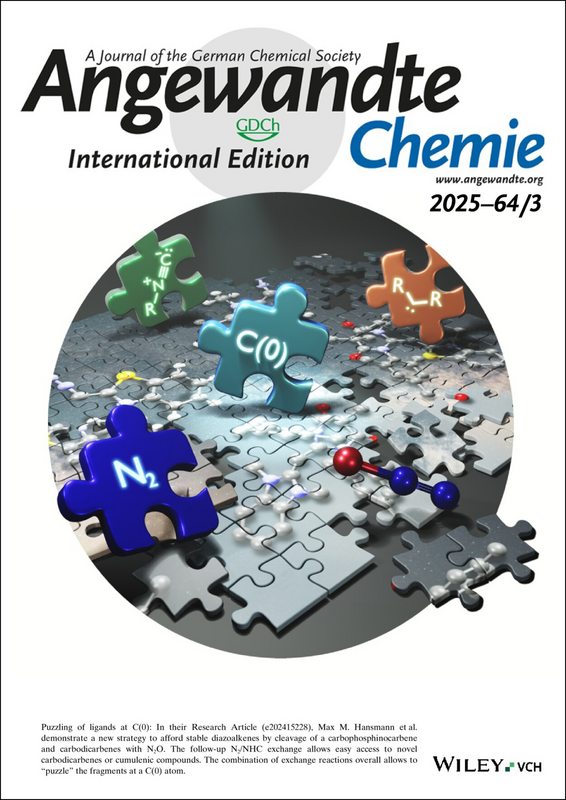
Yijie’s article and art appeared online in Angew. Chem. Int. Ed. and on its front cover. Congratulations for the scientific and artistic work!

The annual group visit to the Christmas market.
Merry Christmas!

Max Hansmann receives the Klung-Wilhelmy Science prize in Berlin. A great honor and success for the group!

Taichi, Annika and Chris presented their work at the ORCHEM conference 2024 in Regensburg.

The groups first publication in Science! We report on a new reagent - Ph3PCN2 - for organic synthesis. Amazing achievement by the group. Congratulations!
Max Hansmann was elected as member of the inaugural Early Career Advisory Board of Organic Chemistry Frontiers. More information.
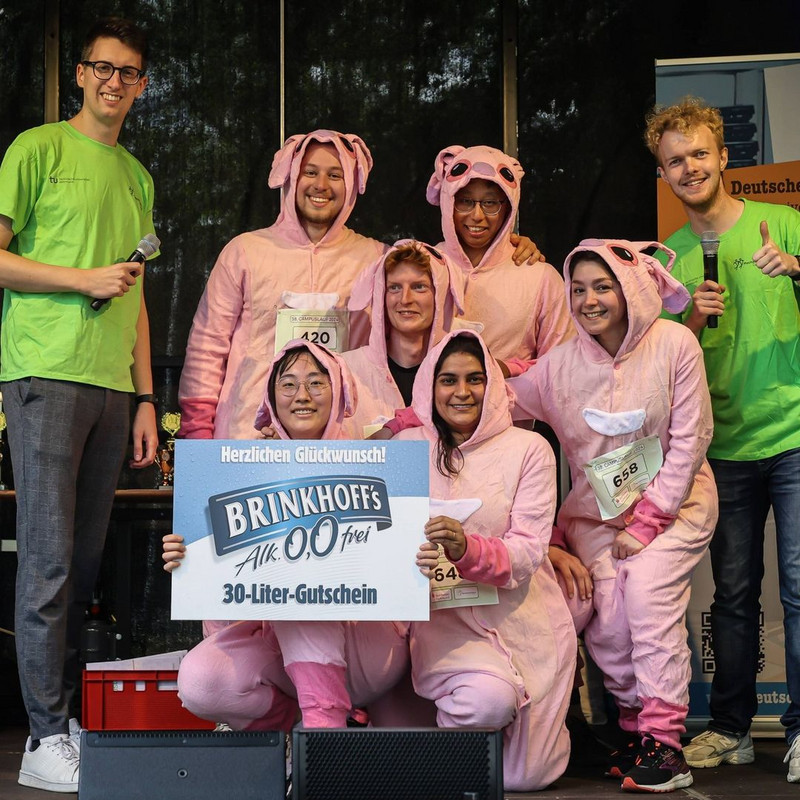
Team Hansrun" won the costume competition in this years Campus run of the TU Dortmund. Besides this fun event our postdocs Taichi and Nicolas participated in the 10 km race with impressing finishing times. The team is eager to defend its costume title in the next year.

Max Hansmann got tenured and is now full professor at the faculty

Our group takes part in the “RESOLV Student Challenge 2024”. Win a paid and organized three month research stay in our group organized by RESOLV. Applications are possible from 09.10.2023-31.12.2023 (or 01.06.2024). Periods for the research stay can be selected between February 2024 till August 2024.

Justus presents his work on diazoalkenes on the “Dream Reactions” Symposium at the WWU Münster

Dr. Taichi Koike from the Iwamoto lab (Tohoku University, Japan) joins our lab as the first Alexander von Humboldt scholar. Welcome!

Justus presents his work on diazoalkenes on the ESOC conference (09.07.-13.07) in Ghent, Belgium
We are a new member of the Cluster of Excellence “RESOLV” which focusses on solvation effects in chemistry. More Information.

Patrick received the poster prize at the JungChemiker Symposium Ruhr 2023. Congratulations!

Yijie joined our group as our newest PhD student in 2023. She comes all the way from Nanjing University with a CSC scholarship. Welcome!

The group receives the prestigious ERC Starting grant for the project CC-CHARGED. The next five years we will study fundamental new organic compound classes, new bond polarization strategies, novel reagents for organic synthesis and more. Congratulations to the group!

Patrick receives the presentation award at the meeting “Academia meets industry” in Bieberach an der Riss at Boehringer-Ingelheim. Congratulations!

Max Hansmann receives the ORCHEM award of the Liebig association of the German Chemical Society. A great honor and congratulations to the group!

Max Hansmann receives the „Dozentenpreis“ des „Fonds der chemischen Industrie“. A great honor and congratulations to the group!

Max Hansmann receives the ADUC prize of the GDCH on the Chemiedozententagung in Saarbruecken. A great honor and big congrats to the team

Max Hansmann receives the “Otto-Röhm-Gedächtnispreis” and was appointed as “Member of the Science of Synthesis Early Career Advisory Board”.

Max Hansmann receives the Ernst-Haage prize 2021 of the Max-Planck-Institute (CEC and KOFO). Congrats to the team!

Our discovery of a new room temperature stable organic functional group is published online in Nature Chemistry.

The Hansmann Group joined Twitter.

Justus joined our group as our newest Ph.D. student in 2020. Welcome!
Emmy Noether Program of the German Research Foundation
Our group received funding from the DFG as part of the Emmy Noether program. The research will combine experimental work from organic and inorganic chemistry and focus on the application of strong electron donors, such as organic hybrid molecules, in the fields of electro- and photo‑chemistry. Applications of interested candidates can be directly send by email to max.hansmann@tu-dortmund.de
SPP 2248 – Polymer Batteries
In collaboration with the research groups Theatό (KIT) and Bresser (Helmholtz Ulm) we received funding for the development of organic polymer batteries (DFG funding program SPP 2248). This interdisciplinary project (small radicals, polymer synthesis and battery assembly) will focus on the synthesis and physical characterization of small redox-active, paramagnetic organic molecules.