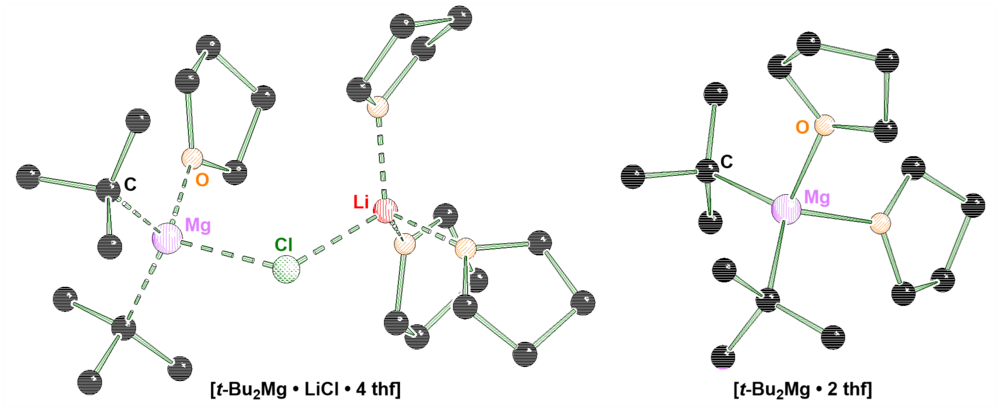
Part of the Turbo Grignard puzzle unraveled
The field of application of organo-magnesium halides, named as Grignard reagents after Victor Grignard (Nobel laureate in 1912), covers many areas of synthetic chemistry such as simple electrophilic addition and halogen exchange reactions, precursors of complex coupling reactions, and the synthesis of optoelectronically active polymers. These commonly used and commercially available reagents are still the subject of intensive and extensive scientific research more than 100 years after their discovery. The reason for this, besides the continuous development of the technologies and the reagents themselves, is the high number of equilibria that are formed between the possible structures. These equilibria are summarized by the Schlenk equilibrium and have since been regarded as a "chemical puzzle" in the context of organo-metallic chemistry.
The development of the Turbo-Grignard reagent by Paul Knochel took the organo-magnesium halide reagent class to a whole new level. In this process, a significant increase in reactivity and chemoselectivity was achieved by the simple addition of lithium chloride. While an increase in yield and a reduction in reaction time were observed, the reaction conditions applied were milder and the tolerance to functional groups was higher. However, many studies aimed at elucidating a possible reactive species have so far only been able to provide insight into the high diversity and high dynamic behavior of the Schlenk equilibrium.
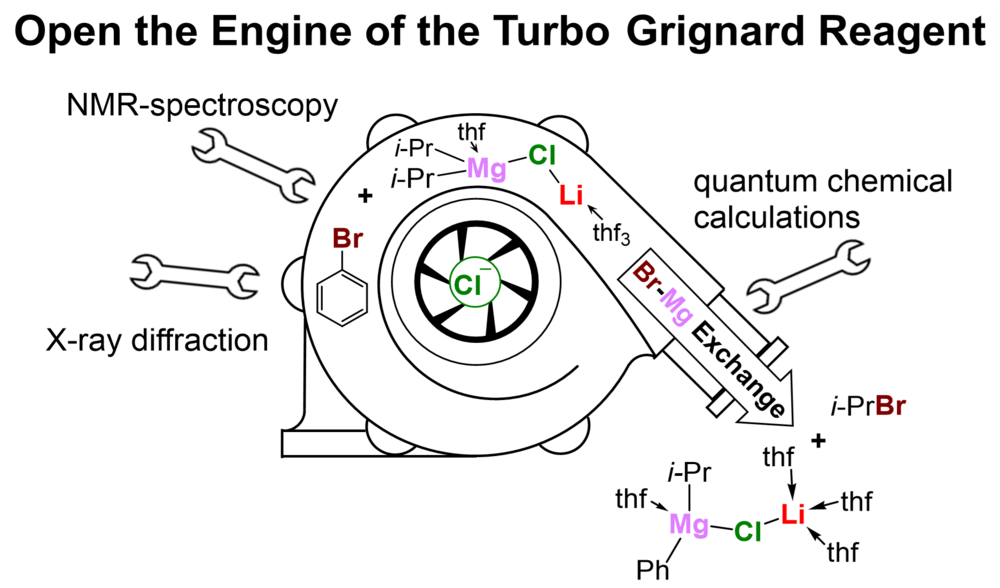
A TU Dortmund University cooperation group consisting of members of Prof. Dr. Carsten Strohmann's working group and Prof. Dr. Wolf Hiller's NMR team has now succeeded in identifying a possible reactive species of the Turbo Grignard reagent in the solid state, detecting it in solution and verifying it by means of quantum chemical calculations. This in-depth study provides a possible explanation for the frequently observed increase in reactivity of the Turbo Grignard reagent, in that the transition state of corresponding reactions can be energetically stabilized by incorporating the lithium chloride into a diorgano-magnesium compound. The formation of this bimetallic species from a stable diorgano-magnesium compound and a formal salt seems surprising at first, but turns out to be a piece in deciphering the Turbo Grignard puzzle. The publication was published in the renowned journal Angewandte Chemie.
Comprehensive Study of the Enhanced Reactivity of Turbo-Gignard-Reagents
A. Hermann, R. Seymen, L. Brieger, J. Kleinheider, B. Grabe, W. Hiller, C. Strohmann*
Angew. Chem. Int. Ed. 2023, e202302489.